






Batik Print vs Hand Batik: What Is the Real Difference?
Batik sarees have a charm that is difficult to replicate. The flowing patterns, beautiful colour combinations and characteristic cracked designs give Batik a distinctive handcrafted appearance. But when you shop for a Batik saree today, you may come across two very different terms — Batik Print and Hand Batik.
They may look similar in photographs, but they are not necessarily the same.
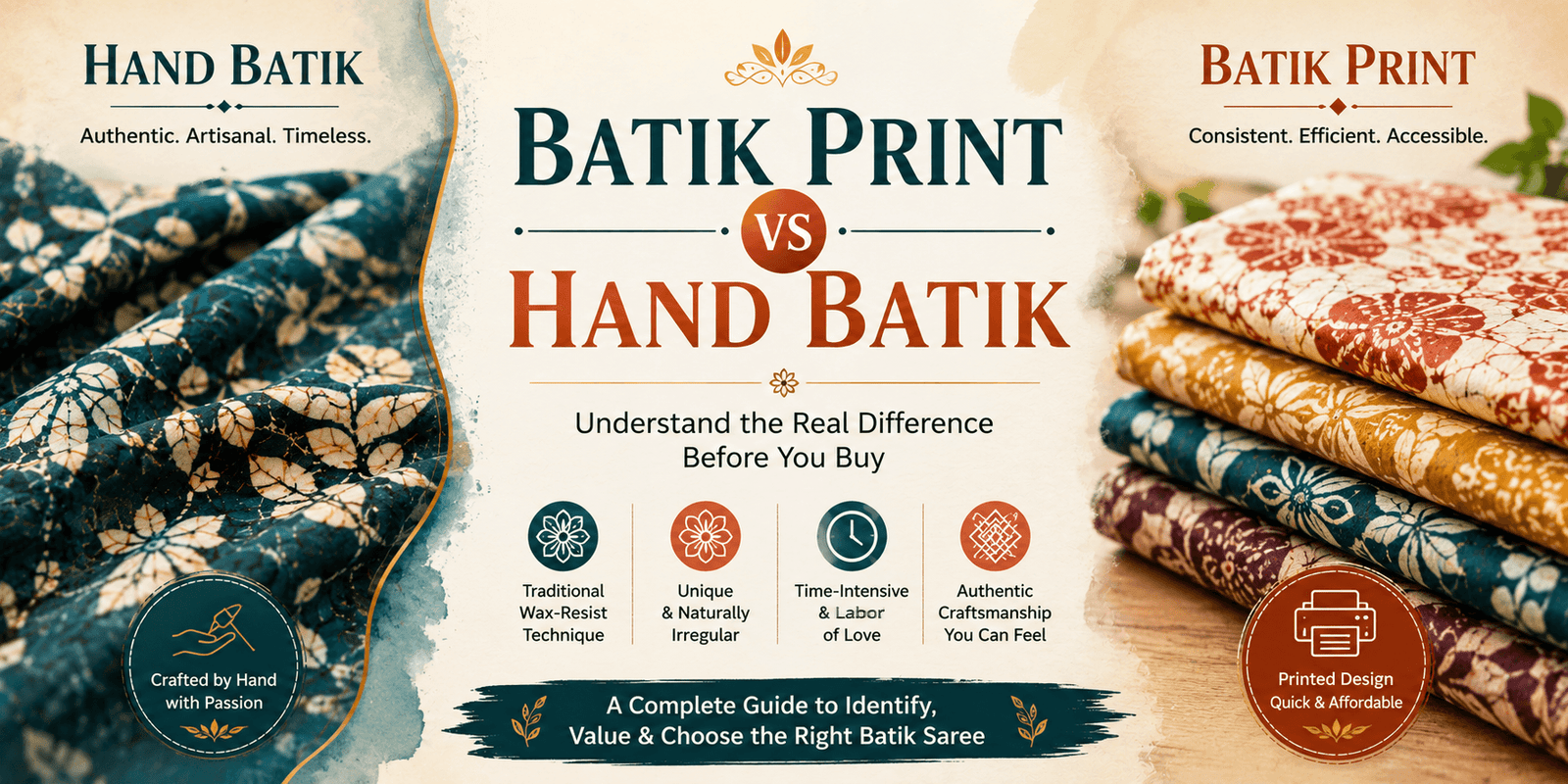
A Hand Batik saree is created through a labour-intensive wax-resist dyeing process, while the term Batik print is often used for fabrics where a Batik-inspired design has simply been printed onto the surface.
So, how can you tell the difference? And more importantly, is Hand Batik actually better?
Let’s understand Batik Print vs Hand Batik in detail.
What Is Batik?
Batik is traditionally a wax-resist dyeing technique.
Instead of simply printing a finished design onto fabric, selected portions of the cloth are covered with wax. The wax prevents dye from reaching those areas when the fabric is dyed.
The artisan can repeat the process with different colours, gradually building a complex design.
One of Batik’s most recognisable characteristics is its beautiful crackle effect. Fine cracks can develop in the wax during the process, allowing small amounts of dye to penetrate. These irregular lines become part of the character of the finished fabric.
This is why genuine handcrafted Batik often has small variations rather than looking mechanically perfect.
What Is Hand Batik?
Hand Batik is Batik created using the traditional wax-resist process with substantial manual involvement.
The exact technique can vary depending on the artisan and design, but the basic process usually involves:
- Preparing the fabric
- Creating or marking the design
- Applying hot wax to selected portions
- Dyeing the fabric
- Drying and processing it
- Reapplying wax where another colour is required
- Repeating the dyeing process
- Removing the wax
- Washing and finishing the fabric
For elaborate multicoloured Batik, some of these stages may be repeated several times.
That is one reason why Hand Batik sarees can take considerably more time and skill to produce than ordinary printed sarees.
What Is Batik Print?
This is where buyers often become confused.
The phrase “Batik print” can be used quite broadly in the textile market.
In many cases, it refers to a fabric carrying a Batik-style printed pattern rather than a design produced through traditional wax-resist dyeing.
The motifs, crackle lines and colour effects may be recreated through screen printing, digital printing or another commercial printing process.
From a distance — and especially in online photographs — a good Batik print can resemble Hand Batik.
But the production methods are fundamentally different.
In simple terms:
Hand Batik: The pattern develops through wax application and dyeing.
Batik Print: A Batik-inspired pattern is printed onto the fabric.
This distinction becomes particularly important when you’re paying a premium for handcrafted work.
Batik Print vs Hand Batik: Quick Comparison
| Feature | Hand Batik | Batik Print |
|---|---|---|
| Technique | Wax-resist dyeing | Printing |
| Manual work | High | Usually lower |
| Pattern | Naturally variable | More uniform |
| Crackle effect | Can occur naturally | Often printed/reproduced |
| Production time | Longer | Faster |
| Uniqueness | Each piece can vary | Multiple pieces can look identical |
| Price | Usually higher | Usually more affordable |
| Craft value | High | Primarily design/fashion value |
Neither category needs to be considered “bad.” They simply represent different products.
The problem arises when an ordinary printed fabric is marketed at a handcrafted price without clearly explaining its production method.
How to Identify Hand Batik
If you are buying an expensive Batik saree, knowing a few characteristics can help.
1. Look for Natural Irregularities
Handcrafted Batik does not always have the machine-perfect consistency of digital printing.
Look closely at:
- Motif outlines
- Colour boundaries
- Repeated designs
- Crackle patterns
- Small variations in dye
Minor irregularities can actually be signs of handmade work.
However, irregularity alone cannot prove that something is Hand Batik.
2. Examine the Crackle Effect
The characteristic Batik crackle is created when dye enters tiny cracks in the wax.
In genuine wax Batik, these lines often appear organic and unpredictable.
Printed Batik can imitate crackles extremely well, but repeated or overly identical crackle patterns may indicate that the effect was printed.
3. Compare Repeated Motifs
Imagine two flowers on the same saree.
In mass-printed fabric, they may be almost perfectly identical.
With handmade work, there may be subtle differences in outline, colour penetration or wax boundaries.
Those tiny differences are part of the beauty of handcrafted textiles.
4. Check Both Sides of the Fabric
Depending on the fabric, dyes and technique used, colour from resist dyeing may be visible through the material rather than sitting primarily as a surface print.
Comparing the front and reverse can therefore provide useful clues.
However, this should not be treated as a foolproof test because penetration varies according to fabric thickness, dyes and production technique.
5. Ask the Seller About the Technique
One of the simplest questions is:
“Is this wax-resist Hand Batik, or is it a Batik-style printed design?”
A knowledgeable seller should be able to explain how the saree was produced.
If you’re purchasing premium handmade textiles online, detailed product descriptions and close-up photographs can also help you make a more informed decision.
Why Does Hand Batik Cost More?
When comparing Batik Print vs Hand Batik sarees, price differences can sometimes be significant.
The reason isn’t simply the appearance of the finished saree.
You’re also paying for the process behind it.
Hand Batik involves skilled labour, wax application, dyeing, drying, washing and finishing. Multicoloured pieces may require several rounds of wax-resist work.
Commercial printing, on the other hand, allows the same design to be reproduced much faster and at larger scale.
Therefore, a genuine Hand Batik saree usually carries greater craft and labour value.
Does Hand Batik Mean Every Design Is Drawn Freehand?
Not necessarily.
This is another common misunderstanding.
“Hand Batik” primarily refers to the wax-resist craftsmanship involved in creating the design. Different Batik traditions and workshops may use different methods of applying wax and developing motifs.
Therefore, handmade does not automatically mean that every single line was spontaneously drawn without any tools or guides.
When evaluating a saree, it is better to understand its actual production process rather than relying only on labels such as “handmade” or “hand-painted.”
Which Is Better: Batik Print or Hand Batik?
That depends on what you want.
Choose Hand Batik if you value:
- Traditional craftsmanship
- Artisan-made textiles
- Individual variations
- Wax-resist designs
- Sarees with greater craft value
- Pieces that feel less mass-produced
Choose Batik Print if you want:
- A Batik-inspired appearance at a lower price
- Consistent patterns
- More affordable everyday fashion
- A wider variety of commercially produced designs
A beautiful printed Batik-style saree can still be an excellent fashion purchase.
But if your priority is authentic craftsmanship, traditional Hand Batik is the more meaningful choice.
Hand Batik Sarees on Different Fabrics
Batik work is not limited to one type of material.
Depending on the artisan and region, Batik techniques can be applied to different fabrics, including cotton and silk-based textiles.
The final appearance changes dramatically according to the base fabric.
On cotton, Batik can have an earthy, artistic and casual character. On silk and silk-blend fabrics, the colours and wax-resist patterns can create a richer appearance suitable for festive and occasion wear.
For saree lovers, this combination of traditional Batik craftsmanship and premium fabric can make each piece particularly attractive.
Is Every Hand Batik Saree Exactly the Same?
No — and that is part of its appeal.
With handcrafted textile work, minor differences may occur between pieces.
Colour distribution can vary slightly. Crackle lines may develop differently. Motifs can show subtle changes.
These variations should not automatically be considered defects.
Instead, reasonable variations can reflect the manual nature of the process.
That is very different from mass production, where hundreds of metres of fabric may reproduce essentially the same design.
Hand Batik vs Machine Print: Why It Matters When Shopping Online
Online saree shopping makes identification more challenging because buyers cannot physically examine the fabric before purchasing.
High-quality photography can also make printed Batik look remarkably similar to handmade work.
Before buying a premium Batik saree online, check:
- Whether the description specifically mentions Hand Batik
- What Batik technique has been used
- The fabric composition
- Close-up photographs of the work
- Front and reverse views when available
- Seller information and product details
- Whether the price is reasonable for the claimed craftsmanship
A trustworthy description should tell you more than simply “Batik saree.”
Frequently Asked Questions About Batik Print vs Hand Batik
Is Batik a print?
Traditional Batik is more accurately described as a wax-resist dyeing technique rather than conventional surface printing. However, “Batik print” is also commonly used commercially for printed fabrics featuring Batik-inspired designs.
How can I tell if Batik is handmade?
Look for natural variations, organic crackle effects and differences between repeated motifs. Examining both sides of the fabric and asking the seller about the production technique can also help. No single visual test is completely foolproof.
Why is Hand Batik expensive?
Hand Batik requires skilled manual work and multiple stages of waxing, dyeing, drying, washing and finishing. Complex designs and multiple colours can increase both labour and production time.
Is Batik Print fake Batik?
Not necessarily. A Batik-style printed saree can be a legitimate textile product as long as it is accurately described. The important distinction is whether the design was printed to resemble Batik or actually created through a wax-resist Batik process.
Is every Hand Batik saree unique?
Handcrafted production naturally creates small variations, so two pieces may not be perfectly identical even when they share the same overall design.
Final Thoughts
When comparing Batik Print vs Hand Batik, the biggest difference isn’t simply what you see — it’s how the design was created.
Printed Batik reproduces the visual language of Batik through commercial printing techniques. Hand Batik uses wax resistance and dyeing to physically develop the pattern on the fabric.
Both can be beautiful.
But for someone who appreciates traditional textiles, artisan craftsmanship and the individuality of handmade work, Hand Batik has a character that mass printing cannot completely reproduce.
The tiny irregularities, unpredictable crackle lines and subtle differences are not necessarily imperfections. They can be evidence of the human process behind the textile.
So the next time you see two similar-looking Batik sarees with very different prices, don’t judge them from the design alone.
Ask the most important question:
Was this design printed onto the saree — or was it actually created through the Batik wax-resist process?
Understanding that difference will help you choose a saree based not only on how beautiful it looks, but also on the craftsmanship you are actually paying for.