







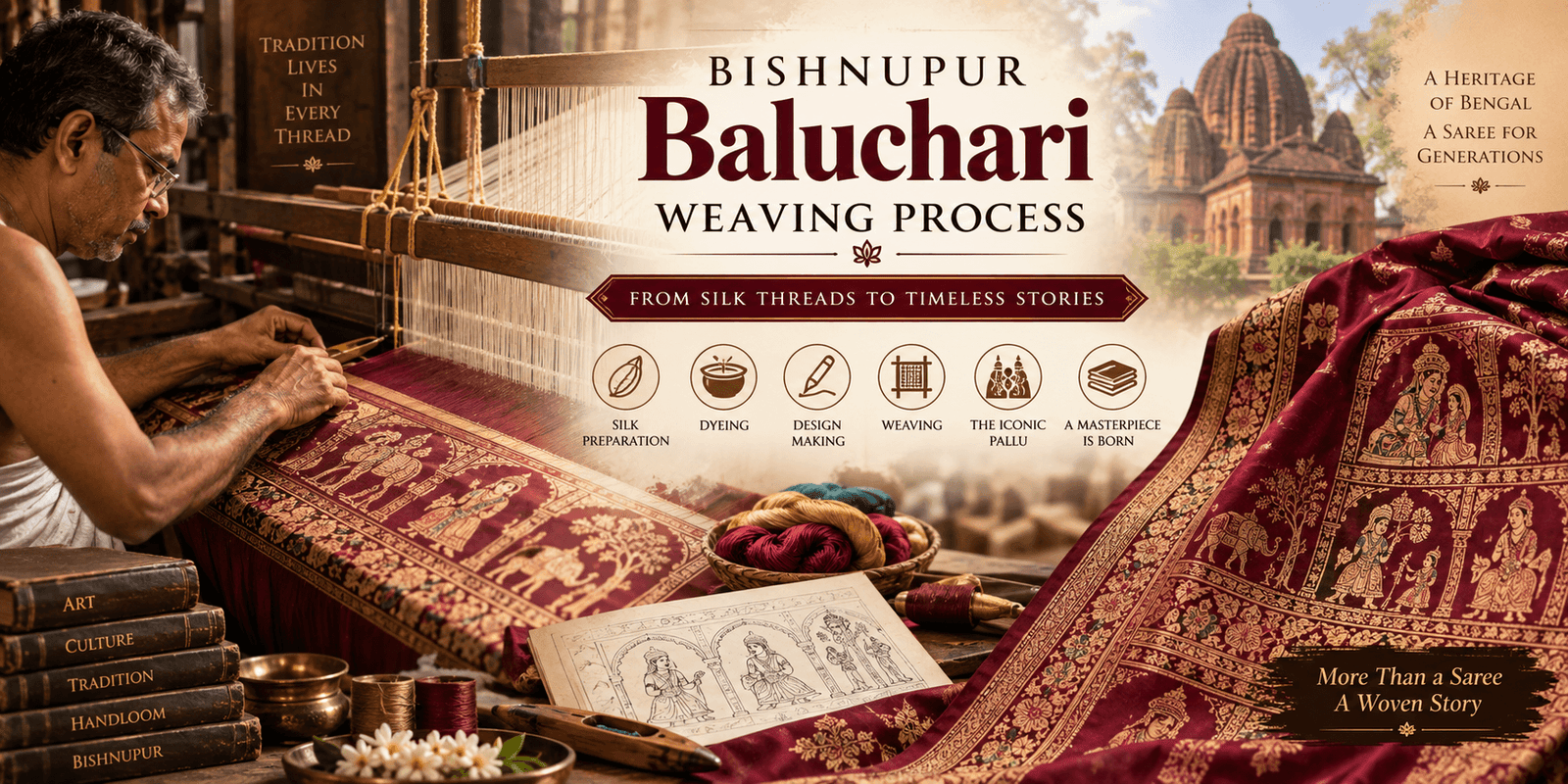
Bishnupur Baluchari Weaving Process: How a Baluchari Saree Is Made
Look closely at the pallu of a traditional Baluchari saree and you may discover something remarkable.
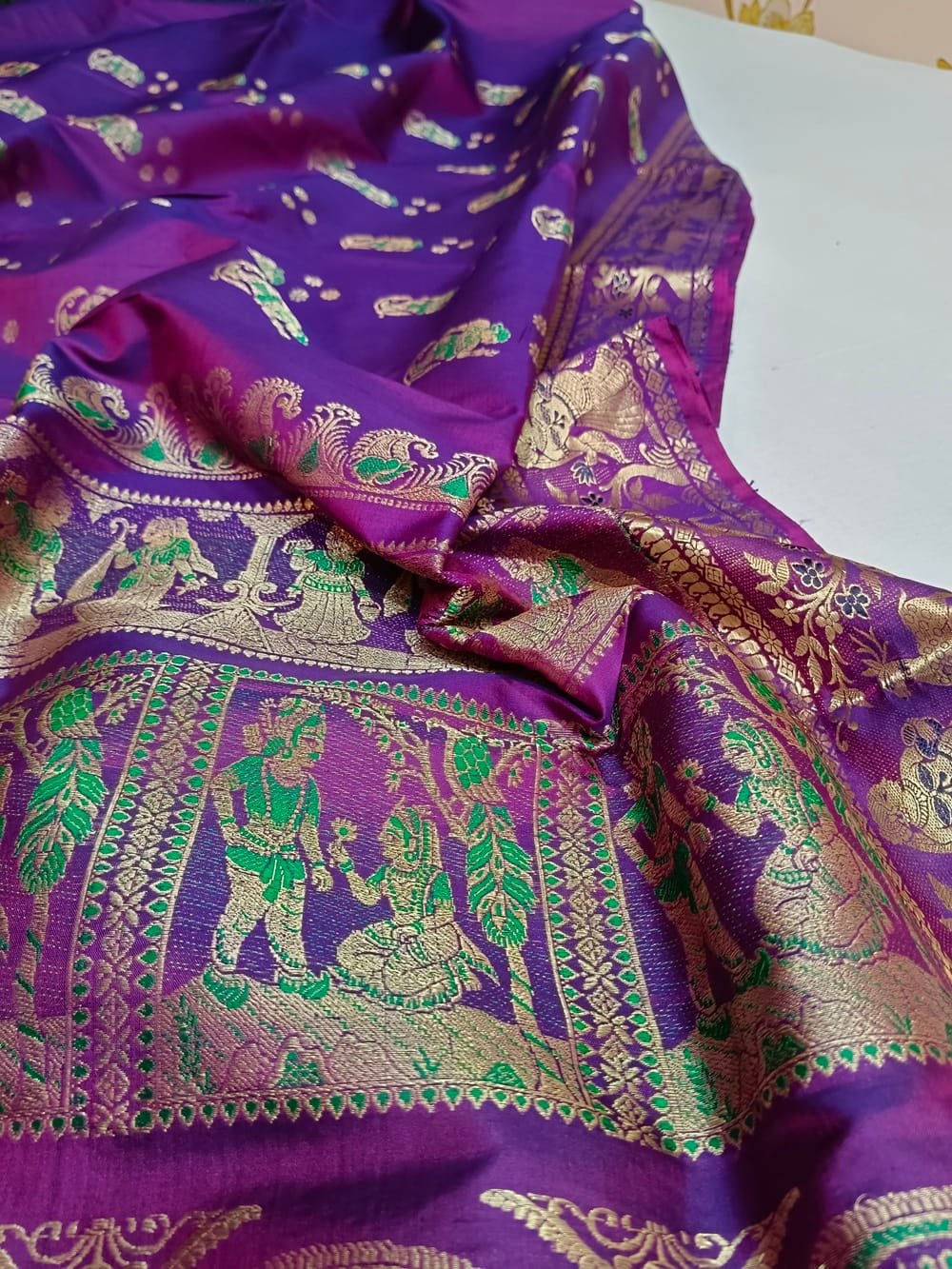
Instead of simple decorative patterns, you can find human figures, flowers, animals, scenes inspired by mythology and intricately arranged narrative motifs — all appearing as part of the weave.
This is what makes a Bishnupur Baluchari saree so fascinating.
The design is not simply printed over a finished piece of silk. Its decorative elements are created during weaving through an elaborate process requiring planning, technical skill and enormous patience.
But how is a Baluchari saree actually made?
To understand its beauty, let’s travel metaphorically to Bishnupur in Bankura, West Bengal, and follow the Bishnupur Baluchari weaving process from design to finished saree.
What Is a Bishnupur Baluchari Saree?
Baluchari is one of Bengal’s most recognisable silk weaving traditions.
The craft has historical roots associated with Baluchar in Murshidabad. Over time, Bishnupur in present-day Bankura district emerged as the major centre associated with Baluchari weaving.
Today, Bishnupur Baluchari sarees are particularly known for their elaborate pallus, decorative borders and figurative motifs.
While many Indian sarees use flowers, paisleys and geometric patterns, Baluchari is especially famous for incorporating storytelling into textile design.
Depending on the design, you may encounter motifs depicting:
- Mythological figures
- Krishna and Radha
- Traditional human figures
- Animals and birds
- Floral elements
- Social or cultural scenes
- Architectural and decorative motifs
The pallu often becomes the visual centrepiece of the saree.
And creating that complexity begins long before the actual weaving starts.
Step 1: Selecting and Preparing the Silk
The Baluchari saree making process begins with the yarn.
Silk yarn has to be prepared so that it can withstand the weaving process while maintaining the smoothness and lustre expected from a fine silk saree.
Preparation may involve processes such as cleaning, twisting or organising yarn according to the requirements of the saree.
The quality of the silk matters enormously.
Even the most beautiful design cannot achieve its full effect if the underlying yarn is poorly prepared.
Once the yarn is ready, the next major consideration is colour.
Step 2: Dyeing the Yarn
Baluchari sarees are known for rich colour combinations.
The silk yarn is dyed according to the planned colour palette of the saree.
Depending on the design, the weaver may need yarn for:
- The main body
- Border
- Pallu
- Contrasting motifs
- Additional decorative details
Colour selection plays an important role in how clearly the woven motifs will eventually appear.
Deep maroon, red, purple, blue, green and other rich shades have long been associated with Baluchari, although contemporary sarees are now available in a much wider palette.
The dyed yarn must then be properly dried and prepared before weaving.
Step 3: Creating the Baluchari Design
This is where the transformation from silk to storytelling textile really begins.
A Baluchari design has to be carefully planned before it can be reproduced on the loom.
The artisan or designer determines:
- The body motifs
- Border pattern
- Pallu composition
- Placement of figurative elements
- Repetition of motifs
- Colour relationships
The pallu requires particular attention because it may contain several figures and decorative elements arranged together as one composition.
Think of it as creating an illustration — except the final illustration has to be translated into interlacing threads.
That makes textile designing very different from drawing on paper.
Step 4: Translating the Design for the Loom
Once the design is finalised, it must be converted into instructions that the loom can reproduce.
Traditionally, complex woven designs have relied on systems that control which threads are lifted during weaving. Baluchari weaving became closely associated with Jacquard technology, which allows intricate repeated motifs to be woven efficiently.
A design is therefore translated into a format suitable for the Jacquard mechanism.
Historically this involved punched-card systems. Contemporary workshops may use updated design-development methods, but the fundamental objective remains similar:
Convert a visual design into a sequence that controls the threads during weaving.
This stage requires technical precision.
A small mistake in the design translation can affect how the motif appears in the finished saree.
Step 5: Preparing the Warp
Before weaving can start, the loom must be prepared.
The warp consists of the long threads running lengthwise through the saree.
These threads need to be measured, aligned and arranged with considerable care.
Maintaining proper tension is crucial.
If the warp tension is inconsistent, it can affect:
- Fabric structure
- Surface appearance
- Motif clarity
- Saree dimensions
- Overall finish
Loom preparation may not be the most visually glamorous part of Baluchari production, but it forms the foundation of everything that follows.
Step 6: Setting Up the Loom and Jacquard
After the warp is prepared, the loom has to be configured for the particular saree design.
For complex Baluchari motifs, the Jacquard mechanism controls groups of warp threads so that detailed patterns can emerge as the weft passes through.
This is what makes intricate figurative weaving possible.
The weaver must coordinate the loom, yarn and pattern mechanism accurately.
At this point, months or years of accumulated weaving experience become extremely important.
The loom may provide the mechanism, but it does not replace the craftsperson.
The weaver still controls the rhythm, yarn handling, tension, colour changes and overall quality of the textile.
Step 7: Weaving the Body of the Baluchari Saree
Now the actual Bishnupur Baluchari weaving process begins.
The weft thread passes across the warp repeatedly, gradually building the fabric.
Body motifs appear according to the planned design.
This is slow, concentrated work.
The weaver needs to continually watch for problems such as:
- Broken threads
- Incorrect tension
- Pattern irregularities
- Yarn entanglement
- Errors in motif formation
Unlike printing, where decoration can be added onto already produced fabric, woven motifs become structurally integrated into the textile during weaving.
This is one reason a close look at an intricately woven Baluchari can be so rewarding.
Step 8: Weaving the Border
The border helps define the character of the saree.
Traditional Baluchari borders may include floral, figurative or ornamental designs that visually connect the body with the more elaborate pallu.
The border must remain consistent throughout the length of the saree.
Maintaining that repetition requires continuous attention from the weaver.
It is also important that the border complements rather than overwhelms the body design.
Step 9: The Most Fascinating Part — Weaving the Pallu
If there is one area where Baluchari craftsmanship truly announces itself, it is the pallu.
The pallu can contain elaborate arrangements of figures, decorative panels and narrative scenes.
Depending on the saree, you may see mythological characters or other traditional motifs arranged within architectural or ornamental frames.
Instead of being painted onto the saree afterwards, these details emerge through weaving.
Imagine constructing a human figure not with a pencil or brush but through the controlled intersection of warp and weft threads.
That gives you some idea of the precision involved.
Complex pallu designs naturally demand more attention and time than simple motifs.
For many collectors and saree lovers, the pallu is therefore the first place to look when appreciating the craftsmanship of a Baluchari.
Step 10: Checking the Finished Weave
The work does not simply end when the final section leaves the loom.
The saree must be inspected for weaving quality.
The artisan may check:
- Motif alignment
- Loose or broken threads
- Border consistency
- Pallu design
- Overall weaving
- Fabric surface
- Finishing
Small loose ends may need careful attention before the saree is considered complete.
Only after inspection and finishing does the saree reach the form in which a customer eventually sees it.
How Long Does It Take to Weave a Baluchari Saree?
There is no single production time for every Baluchari saree.
The time required depends on factors such as:
- Complexity of the design
- Density of motifs
- Pallu detailing
- Number of colours
- Yarn preparation
- Loom setup
- Type of Baluchari
- Skill and working pace of the weaver
An elaborate Baluchari cannot fairly be judged against the production speed of a mass-produced printed saree.
Part of its value comes from the amount of skilled work involved in converting an idea into woven silk.
Baluchari vs Swarnachari: What Changes in the Weaving?
You may often hear Baluchari and Swarnachari mentioned together.
Their visual language is closely related, particularly in the use of elaborate figurative and narrative motifs.
The important distinction is that Swarnachari prominently incorporates metallic zari-like threads, giving the motifs and pallu a richer golden or silver-toned appearance.
A traditional Baluchari may instead rely more heavily on coloured silk threads for its decorative weaving.
Because of the metallic appearance, Swarnachari can look especially opulent and is popular for weddings, festive occasions and traditional celebrations.
Why Are Baluchari Motifs So Special?
Many sarees are admired for beautiful motifs.
Baluchari goes one step further by making narrative imagery an important part of the textile.
The pallu can almost function like a woven canvas.
Figures may appear within individual panels, surrounded by flowers, borders and architectural patterns.
This storytelling quality makes Baluchari immediately recognisable to people familiar with Indian textiles.
It also creates an interesting relationship between fashion and visual culture: a woman wearing the saree is quite literally carrying woven stories with her.
Is Every Bishnupur Baluchari Handmade?
The term “handwoven” should be understood carefully.
The loom may incorporate mechanisms such as Jacquard for controlling complicated patterns, but the saree is woven through the skill and operation of the craftsperson.
Jacquard does not mean the saree is simply produced automatically like a digitally printed textile.
It is a mechanism that enables the weaver to create complex patterns through controlled thread movement.
This distinction is important when understanding the craftsmanship behind a handwoven Baluchari saree.
How to Appreciate a Baluchari Before Buying
When looking at a Baluchari saree, don’t judge it only by its colour.
Take a closer look at:
The Pallu: Examine the complexity and clarity of the main narrative composition.
The Motifs: Look at the definition of human, floral or traditional figures.
The Border: Notice how consistently the design continues along the saree.
The Weave: Look at the overall neatness and structure.
The Silk: Understand what type and quality of silk is being offered.
The Craft Details: Check the product description for weaving, material and certification information where applicable.
A well-informed buyer sees much more than “a silk saree.”
They see the work behind it.
Frequently Asked Questions
Where are Baluchari sarees made?
Bishnupur in Bankura district, West Bengal, is one of the most important contemporary centres of Baluchari weaving.
Is Baluchari woven or printed?
Traditional Baluchari is a woven textile. Its characteristic motifs are created during the weaving process rather than simply being printed onto the finished saree.
What is special about Bishnupur Baluchari?
Bishnupur Baluchari is particularly recognised for elaborate woven borders and pallus featuring figurative, traditional and narrative motifs.
What is the difference between Baluchari and Swarnachari?
Both share a similar storytelling weaving tradition. Swarnachari is especially recognised for the prominent use of metallic zari-like threads in its decorative motifs.
Are Baluchari sarees handwoven?
Traditional Baluchari sarees are handloom-woven. Jacquard mechanisms can assist in controlling the complicated pattern, while the weaving itself requires the skill and operation of the artisan.
From Threads to Stories: The Beauty of Bishnupur Baluchari
The next time you hold a Baluchari saree, look beyond its colour.
Look at a tiny figure in the border.
Follow the pattern towards the pallu.
Notice how one figure becomes a scene and how several scenes together transform silk into a story.
Behind that finished saree lies an entire sequence:
Silk preparation → Dyeing → Designing → Pattern development → Warp preparation → Loom setup → Weaving → Pallu creation → Finishing.
That is what makes the Bishnupur Baluchari weaving process so remarkable.
It is not simply about decorating silk.
It is about translating art into the language of warp and weft — one thread at a time.
And perhaps that is the greatest beauty of a Baluchari saree: before it becomes something to wear, it begins as something to create.