






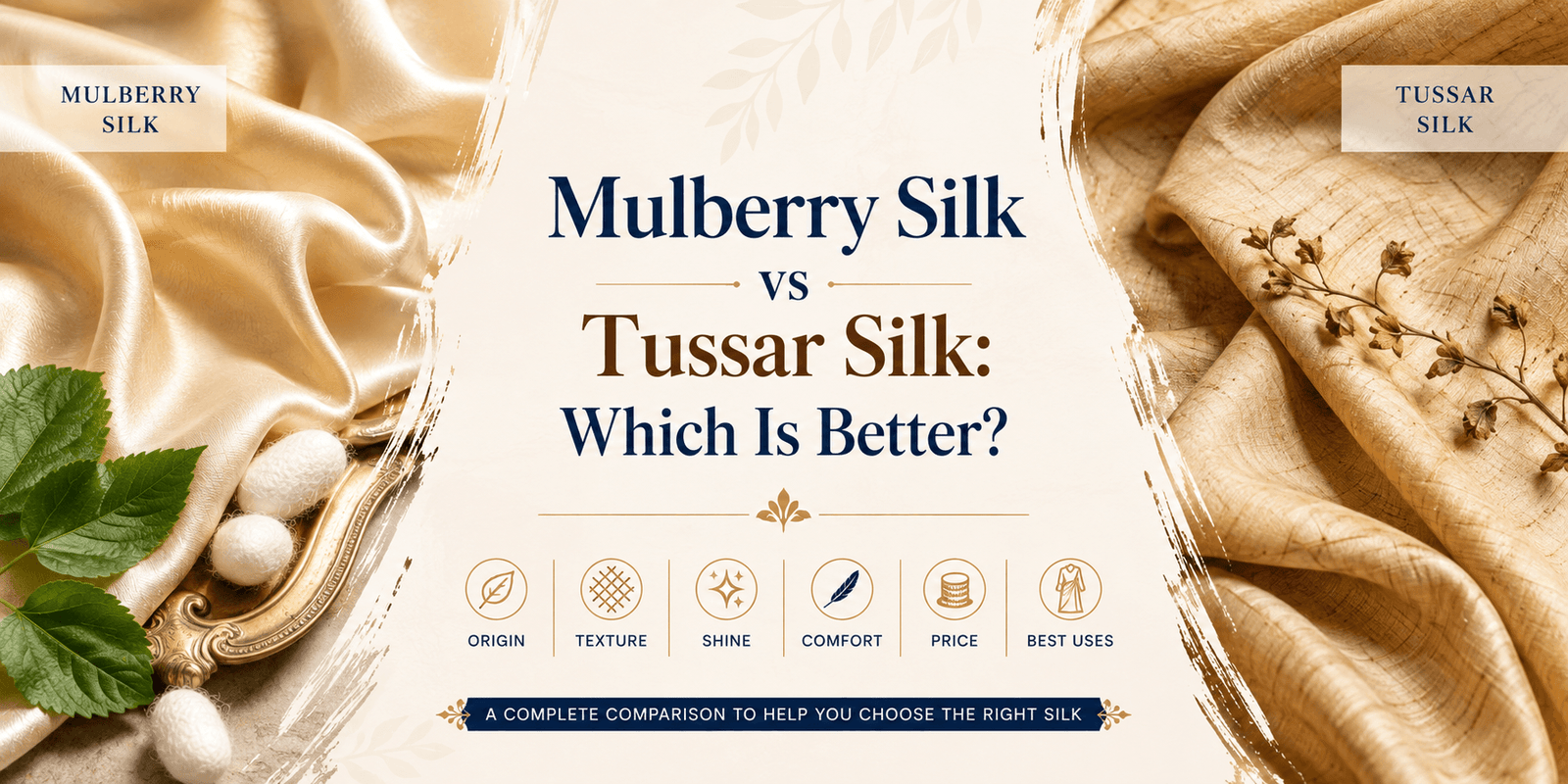
Mulberry Silk vs Tussar Silk: Which Is Better? A Complete Comparison
If you are planning to buy a silk saree, two names you will come across again and again are Mulberry silk and Tussar silk.
Both are beautiful. Both are used in premium Indian textiles. Both can make an elegant saree. Yet, they look and feel surprisingly different.
Mulberry silk is known for its smooth texture, fine fibres and elegant lustre. Tussar silk, on the other hand, has a more natural texture, earthy character and distinctive golden sheen.
So, Mulberry silk vs Tussar silk—which one is better?
The honest answer is: neither is universally better. The right choice depends on what you want from your silk saree—softness, shine, texture, occasion, comfort, durability, or simply your personal style.
In this guide, we’ll compare Mulberry silk and Tussar silk in detail so you can decide which one is right for you.
Mulberry Silk vs Tussar Silk: At a Glance
| Feature | Mulberry Silk | Tussar Silk |
|---|---|---|
| Main characteristic | Smooth and fine | Textured and natural |
| Appearance | Lustrous and polished | Warm, earthy and slightly irregular |
| Fibre | Fine, relatively uniform | More textured |
| Feel | Smooth and soft | Crisp to slightly textured |
| Shine | Usually higher | Usually more subdued |
| Look | Luxurious and refined | Artistic and traditional |
| Common use | Bridal, luxury and festive wear | Handloom, festive and everyday ethnic wear |
| Best for | Grand, polished appearance | Natural, handcrafted appearance |
| Popular Indian traditions | Kanchipuram and many other silk textiles | Tussar and Baluchari traditions |
The important thing to remember is that the final look of a saree depends not only on the silk fibre but also on the yarn, weave, dyeing, zari, finishing and craftsmanship.
What Is Mulberry Silk?
Mulberry silk is produced primarily by the domesticated silkworm Bombyx mori, which feeds mainly on mulberry leaves.
It is one of the most widely used forms of silk in commercial silk production and is particularly valued for its fine, smooth and relatively uniform fibres.
The first thing you usually notice about Mulberry silk is its smooth surface and elegant lustre.
Run your hand over a high-quality Mulberry silk fabric and it tends to feel soft and refined. This makes it particularly attractive for luxurious clothing and traditional silk sarees.
Main characteristics of Mulberry silk
- Smooth texture
- Fine fibres
- Natural lustre
- Soft hand-feel
- Good strength
- Elegant drape
- Suitable for luxury clothing
- Available in many colours and weaving styles
Mulberry silk is often associated with grand traditional sarees, including Kanchipuram silk traditions, although the exact composition of any individual saree should always be checked with the seller.
If your idea of silk is smooth, rich, polished and luxurious, Mulberry silk is likely to appeal to you.
What Is Tussar Silk?
Tussar silk, also known as Tasar or Tassar silk, is produced from several species of wild silkworms and is particularly associated with the forests and textile traditions of eastern and central India.
It has a completely different personality from Mulberry silk.
Instead of an extremely smooth and uniform appearance, Tussar generally has a distinctive natural texture and warm, earthy lustre.
That slight irregularity is actually part of its charm.
Tussar is strongly associated with handloom traditions in states including West Bengal, Jharkhand, Odisha and Chhattisgarh.
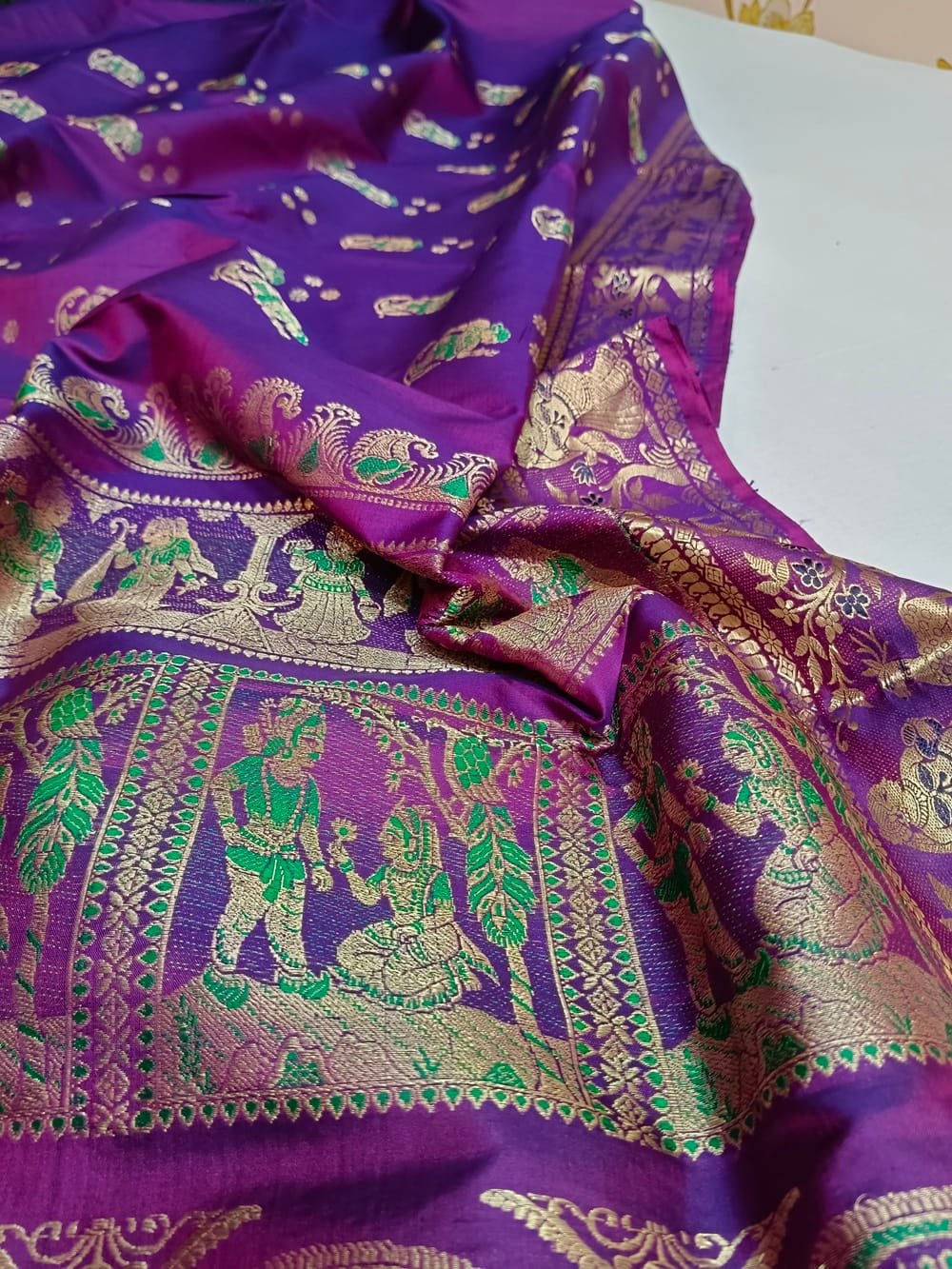
One particularly beautiful example is the Baluchari saree of West Bengal, where Tussar silk has historically been used in elaborate weaving traditions featuring narrative motifs.
Main characteristics of Tussar silk
- Natural textured appearance
- Warm golden or earthy sheen
- Distinctive fibre character
- Comfortable drape
- Strong connection with Indian handloom traditions
- Excellent for artistic and traditional sarees
- Often preferred for a less glossy silk appearance
If you prefer a saree that looks natural, artistic and handcrafted rather than highly glossy, Tussar may be the better choice.
Mulberry Silk vs Tussar Silk: What Is the Difference?
The easiest way to understand the difference is to look at the fibre, texture, appearance and overall personality of the two silks.
1. Difference in Fibre
Mulberry silk generally comes from the domesticated Bombyx mori silkworm, which is primarily raised on mulberry leaves.
Tussar silk comes from wild silkworm species, including species in the Antheraea group.
This difference in production environment contributes to their different fibre characteristics.
Mulberry silk tends to be more uniform, while Tussar has a more naturally varied texture.
2. Mulberry Silk vs Tussar Silk: Texture
This is perhaps the easiest difference to notice.
Mulberry silk
Mulberry silk is generally:
Smooth + soft + fine + polished
It feels luxurious against the skin and has a refined surface.
Tussar silk
Tussar is generally:
Textured + natural + slightly crisp + earthy
Its texture gives the fabric character and makes it especially attractive in handwoven sarees.
Winner for softness: Mulberry silk
If softness is your highest priority, Mulberry silk is usually the safer choice.
If you love texture and natural character, Tussar may win for you.
3. Mulberry Silk vs Tussar Silk: Shine
Mulberry silk generally has a more noticeable, smooth lustre.
It reflects light beautifully and can create the rich appearance people often associate with luxury silk.
Tussar has its own beautiful sheen, but it is usually more subdued and natural-looking.
Rather than looking highly glossy, Tussar often has a warm golden or muted appearance.
Winner for glossy luxury: Mulberry silk
Winner for natural elegance: Tussar silk
This is not really a question of quality. It is a question of aesthetics.
4. Which Is More Comfortable?
Both can be comfortable, but the experience is different.
Mulberry silk is smooth and soft, making it particularly pleasant for people who prefer fabrics with a refined surface.
Tussar has a more textured hand-feel. Many people love this because it gives the saree a distinctive handcrafted character.
For warm weather, the comfort of a saree also depends on its weave, weight, construction and lining, not just the type of silk.
So don’t choose a silk saree based only on the fibre name.
5. Which Is More Durable?
Silk is a strong natural fibre, but durability depends on much more than whether the saree is Mulberry or Tussar.
The quality of yarn, weaving, dyeing, finishing, zari and care all affect the lifespan of a saree.
A high-quality handwoven Tussar saree can become a treasured heirloom, while a poorly made Mulberry silk product may not have the same longevity.
The better approach
Instead of asking:
“Is Mulberry stronger than Tussar?”
ask:
“How well was this particular saree made?”
That is a much more useful question when buying expensive silk.
6. Which Silk Is Better for Weddings?
If you want a grand, rich and polished bridal appearance, Mulberry-based silk traditions can be an excellent choice.
Kanchipuram silk sarees, for example, are famous for their rich colours, traditional motifs, strong borders and elaborate zari work.
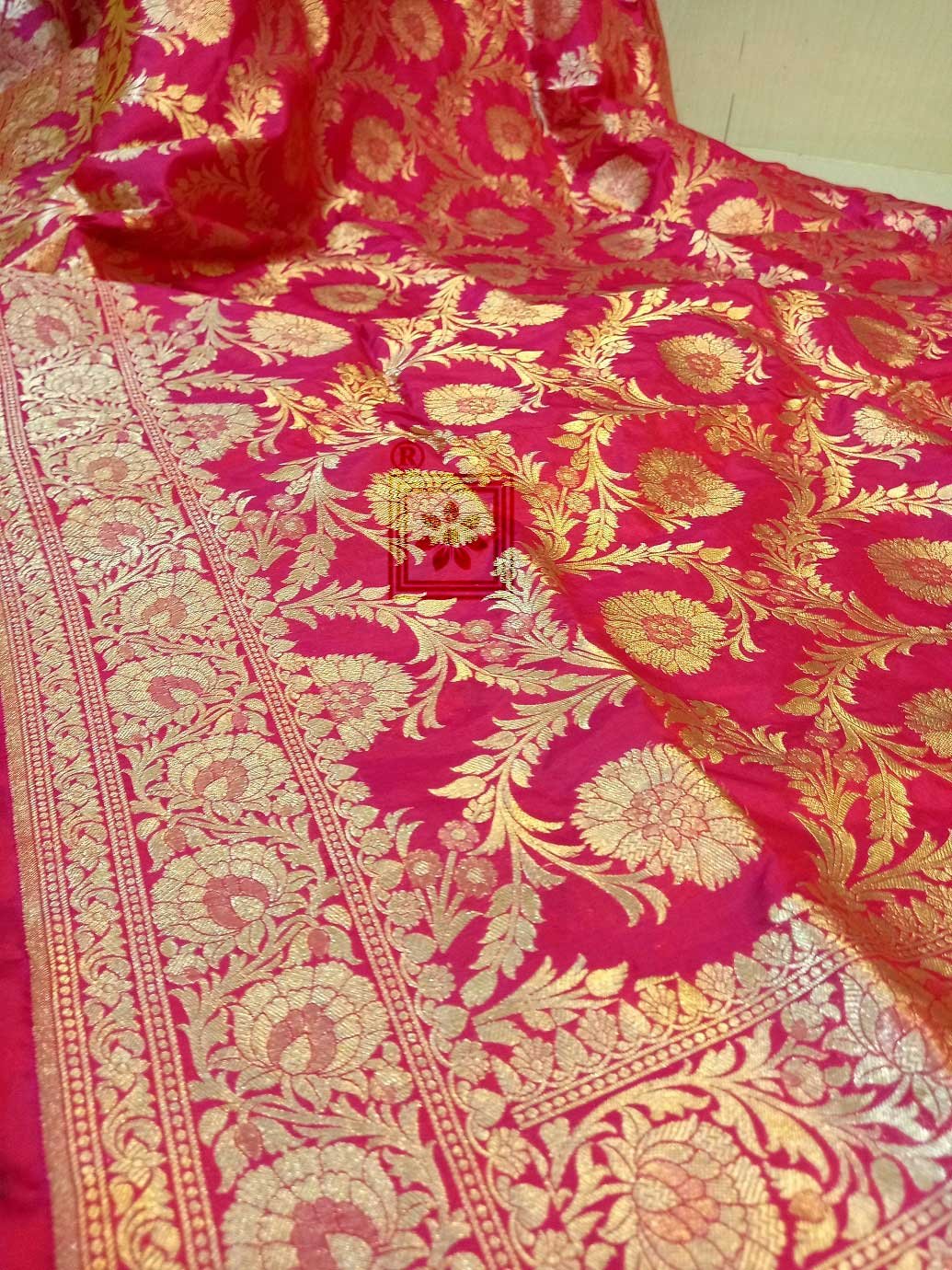
Banarasi silk traditions are another popular choice for brides and wedding guests.
Tussar can also look beautiful at weddings, particularly when it has intricate handloom work, embroidery, painting or traditional motifs.
Choose Mulberry silk if:
- You want a grand bridal appearance
- You prefer smooth, lustrous fabric
- You like rich colours and zari
- You want a traditional luxury look
Choose Tussar silk if:
- You prefer understated elegance
- You love handloom textures
- You want something artistic
- You prefer an earthy or sophisticated look
For a traditional grand wedding: Mulberry often has the advantage.
For a distinctive artistic wedding look: Tussar can be an excellent choice.
7. Which Is Better for Everyday Wear?
This depends heavily on the saree’s weight and weave.
A lightweight Tussar saree can be an excellent option for regular ethnic wear because it combines a natural appearance with traditional character.
A lightweight Mulberry silk saree can also work beautifully for formal or festive occasions.
If you want a silk saree that does not look overly bridal, both can work—just look for simpler designs and lighter constructions.
8. Which Silk Is More Expensive?
This is where many buyers make a mistake.
There is no universal rule that Mulberry silk is always more expensive than Tussar silk—or vice versa.
The price of a silk saree can depend on:
- Silk quality
- Purity
- Yarn quality
- Handloom or powerloom production
- Weaving complexity
- Zari quality
- Design complexity
- Artisan workmanship
- Brand
- Origin
- Certification
- Finishing
- Time required to make the saree
A highly intricate handwoven Tussar saree can cost considerably more than a simple Mulberry silk saree.
Similarly, an elaborate Mulberry silk wedding saree can command a premium price.
Therefore, price alone cannot tell you which silk is better.
9. Mulberry Silk vs Tussar Silk for Sarees
This is where the comparison becomes particularly interesting.
Mulberry silk sarees
Mulberry silk works beautifully when you want:
- Smooth draping
- Rich colours
- Elegant shine
- Bridal grandeur
- Traditional luxury
- A polished appearance
It is a natural fit for celebrations and special occasions.
Tussar silk sarees
Tussar works beautifully when you want:
- Natural texture
- Earthy colours
- Handloom character
- Artistic designs
- Subtle elegance
- A less glossy appearance
Tussar sarees are particularly attractive to people who appreciate the story behind a textile.
Mulberry Silk vs Tussar Silk: Which One Looks More Luxurious?
This depends on what you mean by luxury.
If luxury means shine, smoothness, richness and grandeur, Mulberry silk generally has the advantage.
If luxury means craftsmanship, natural texture, heritage and exclusivity, Tussar can be equally compelling.
This is why experienced saree buyers don’t always look for the shiniest silk.
Sometimes the beauty is in the weave, the texture and the hands that created it.
Which Silk Should You Buy?
Here’s a simple way to decide.
Choose Mulberry silk if you want:
Smoothness
You prefer a soft and refined fabric.
Shine
You like a noticeable silk lustre.
Bridal grandeur
You want a traditional, rich wedding appearance.
Luxury styling
You prefer polished and sophisticated fabrics.
Choose Tussar silk if you want:
Texture
You enjoy the natural character of handloom fabric.
Earthy elegance
You prefer subtle rather than excessive shine.
Artistic designs
You appreciate traditional motifs and storytelling.
Handloom character
You want the fabric to visibly reflect craftsmanship.
Mulberry Silk or Tussar Silk: Which Is Better?
So, finally, which is better—Mulberry silk or Tussar silk?
There is no single winner.
Mulberry silk wins for:
- Smoothness
- Softness
- Fine texture
- Lustre
- Polished appearance
- Grand traditional styling
Tussar silk wins for:
- Natural texture
- Earthy character
- Handloom appeal
- Distinctive appearance
- Artistic designs
- Traditional regional character
If you are buying a silk saree for a grand wedding or formal celebration, Mulberry silk may be the better starting point.
If you want a saree that feels natural, artistic and deeply connected to Indian handloom traditions, Tussar may be the more interesting choice.
And if you already own one, perhaps your next saree should simply be the other.
After all, Mulberry and Tussar are not competitors as much as they are two different expressions of India’s remarkable silk heritage.
How to Identify Good Quality Silk
Whatever silk you choose, don’t rely only on the product name.
Before buying, check:
1. Fibre composition
Ask whether the saree is 100% silk, silk blend or contains other fibres.
2. Weaving
Ask whether it is handwoven or machine-made when that distinction matters to you.
3. Zari
For sarees with zari, ask about the type and composition of the zari.
4. Origin
Regional silk traditions often have specific characteristics, so knowing where the saree was produced can help.
5. Seller transparency
A reliable seller should be able to explain the fabric, weaving method, composition and care instructions.
6. Certification
For expensive silk purchases, relevant certifications or authenticity documentation can provide additional confidence.
Caring for Mulberry and Tussar Silk Sarees
Both Mulberry and Tussar silk deserve careful storage.
Keep silk sarees away from excessive moisture and prolonged direct sunlight. Store them in a clean, dry environment and avoid storing them tightly compressed for very long periods.
It is also a good idea to refold valuable silk sarees periodically so that the same fold does not remain permanently stressed.
For expensive or heavily embellished sarees, professional dry cleaning is often preferable to aggressive home washing.
Always follow the care instructions supplied with the particular saree.
Frequently Asked Questions
Is Mulberry silk better than Tussar silk?
Not necessarily. Mulberry silk is generally smoother and more lustrous, while Tussar has a distinctive natural texture and earthy appearance. The better option depends on your preferred look, comfort and occasion.
Which is more expensive, Mulberry silk or Tussar silk?
Neither is automatically more expensive. Price depends on silk quality, weaving technique, design, zari, craftsmanship, origin and other factors.
Which is softer, Mulberry or Tussar silk?
Mulberry silk is generally smoother and softer to the touch. Tussar has a more textured hand-feel.
Which silk is best for bridal sarees?
Mulberry-based silk traditions such as Kanchipuram are excellent choices for grand bridal sarees. Tussar can also be a beautiful bridal option when combined with elaborate handloom work or traditional designs.
Is Tussar silk pure silk?
Tussar is a genuine silk fibre, but buyers should check the composition of the specific product because products marketed with silk names can vary.
Is Mulberry silk real silk?
Yes. Mulberry silk is genuine natural silk produced primarily by domesticated silkworms that feed on mulberry leaves.
Which silk has more shine?
Mulberry silk generally has a smoother and more pronounced lustre, while Tussar tends to have a softer, warmer and more subdued sheen.
Which is better for handloom sarees?
Both can be excellent. Tussar is particularly appreciated for its natural texture and strong connection with Indian handloom traditions, while Mulberry silk is widely used across many premium weaving traditions.
Final Verdict: Mulberry Silk vs Tussar Silk
If you want smooth, soft, lustrous and luxurious, choose Mulberry silk.
If you want textured, earthy, artistic and naturally elegant, choose Tussar silk.
But don’t let the word “better” make the decision for you.
The best silk is ultimately the one that suits your occasion, your comfort, your style and the story you want your saree to tell.
And that is what makes Indian silk so special. There isn’t one perfect silk—there are many, each with its own character, craftsmanship and history.