






Batik Saree Meaning & Process: How Batik Sarees Are Made in India
A Batik saree is easy to admire but much more interesting once you understand how it is made.
At first glance, you may notice beautiful floral forms, abstract patterns, contrasting colours and the fine crackled lines that give many Batik fabrics their unmistakable character. But unlike an ordinary printed saree, traditional Batik involves a fascinating process in which wax and dye work together to create the design.
Parts of the fabric are covered with wax so that they resist the dye. The cloth is then dyed, waxed again when required, and sometimes taken through several rounds of colouring before the final pattern emerges.
The result is a textile in which no two handcrafted pieces need look exactly alike.
But what exactly does Batik saree mean? How is a Batik saree made? Is Batik a print, a weave or a type of silk?
Let’s understand this beautiful textile art from the beginning.
What Is a Batik Saree?
A Batik saree is a saree decorated using the Batik wax-resist dyeing technique.
Instead of simply applying coloured ink over the surface of the cloth, traditional Batik uses wax to protect selected areas from absorbing dye.
Think of the wax as a temporary barrier.
Where wax has been applied, the dye cannot easily penetrate the fabric. When the wax is eventually removed, those protected portions reveal the original or previously dyed colour underneath.
By repeatedly applying wax and dye, artisans can build surprisingly complex designs.
This technique can be used on different fabrics, which means Batik is not itself a type of silk or a weaving technique.
You can therefore find:
- Batik cotton sarees
- Batik silk sarees
- Batik silk-cotton sarees
- Batik dress materials
- Batik scarves and dupattas
- Batik kurtas and other garments
So when someone says “Batik saree,” the word Batik primarily describes how the pattern has been created, rather than the fibre from which the saree is made.
Batik Saree Meaning in Simple Words
In simple terms:
Batik is a method of creating patterns on fabric by covering selected areas with wax and then dyeing the cloth.
The waxed areas resist the dye.
Once the wax is removed, a pattern appears.
For a multicoloured Batik, this process can be repeated several times using different colours and different waxed areas.
This combination of wax + resist + dye is the basic principle behind Batik.
Is Batik a Print or a Weave?
This is one of the most common points of confusion.
Batik is not a weave.
For example, Banarasi, Baluchari or Jamdani textiles may be recognised largely by distinctive weaving traditions. Batik, on the other hand, is primarily a surface-design and resist-dyeing technique.
People commonly use the expression “Batik print,” and you will frequently see Batik sarees marketed under that name.
However, traditional handcrafted Batik is more accurately understood as a wax-resist dyeing process rather than conventional printing.
The distinction becomes important when shopping because a fabric carrying a Batik-inspired printed pattern is not necessarily made through the traditional wax-resist process.
Where Did Batik Originate?
Batik has a long and rich history, and its most internationally celebrated tradition is closely associated with Indonesia, particularly Java.
The word Batik itself is strongly connected with Indonesian textile culture, and Indonesian Batik has achieved worldwide recognition.
However, resist-dyeing traditions have existed in different parts of the world, and Batik also developed a significant place within Indian textile and craft traditions.
In India, Batik work can be found in several regions, including West Bengal, where artisans and textile designers have created distinctive Batik sarees, dress materials and decorative fabrics.
Over time, Indian artisans adapted the technique to local preferences, fabrics, motifs and colour combinations.
This is why an Indian Batik saree may look quite different from a traditional Indonesian Batik textile while still sharing the fundamental principle of wax-resist dyeing.
What Makes Batik Sarees Special?
The beauty of handmade Batik comes partly from controlled imperfection.
When wax dries on fabric, tiny cracks may develop. During dyeing, colour can enter some of these cracks.
The resulting network of fine irregular lines is known as the crackle effect.
Rather than being considered a defect, this can be one of Batik’s most attractive characteristics.
It gives the design depth, movement and an unmistakably handcrafted appearance.
A digitally printed imitation can reproduce the look of crackles, but traditional Batik creates them as part of the actual wax-and-dye process.
That is one reason handmade Batik can have such an organic personality.
How Is a Batik Saree Made?
The Batik saree making process can vary depending on the artisan, design, fabric and number of colours involved. However, traditional wax-resist Batik generally follows several fundamental stages.
Let’s look at them one by one.
Step 1: Preparing the Fabric
The process begins with selecting suitable fabric.
Cotton and silk are both used for Batik, although their texture and dye behaviour can differ.
Before designing begins, the fabric needs to be properly prepared so that unwanted substances do not interfere with dye absorption.
A clean, well-prepared surface helps produce a better final result.
Step 2: Creating the Design
The artisan decides where the design will appear on the saree.
Depending on the style, the pattern may include:
- Flowers
- Leaves
- Geometric shapes
- Abstract designs
- Traditional motifs
- Nature-inspired elements
- Figurative art
- Borders
- Repeated patterns
- Freehand artistic forms
The design may be sketched lightly onto the cloth or created more freely depending on the artisan’s method.
This stage requires planning because the craftsperson must think not only about the final design but also about which areas should receive which colours during each dyeing stage.
Step 3: Heating the Wax
Wax is prepared for application.
Traditional Batik techniques can use mixtures of waxes, with the exact composition influencing how the wax flows, adheres to the cloth and cracks during processing.
The wax needs to be warm enough to penetrate the relevant part of the fabric but controlled enough for the artisan to create the intended design.
Wax handling is therefore an important skill in Batik making.
Step 4: Applying Wax to the Saree
Now comes the defining stage of the Batik process.
Wax is applied to all areas that the artisan wants to protect from the next dye colour.
The wax can be applied using different tools and techniques.
Depending on the tradition and design, artisans may use:
- Brushes
- Blocks or stamps
- Special wax-applying tools
- Freehand techniques
Wherever the wax properly covers the cloth, that portion resists the next dye bath.
Imagine starting with a white fabric.
If the artisan covers a flower motif with wax and then dyes the entire fabric blue, the surrounding fabric becomes blue while the protected flower can remain white.
This simple principle can be repeated to create far more complicated designs.
Step 5: The First Dyeing
Once the selected areas have been waxed, the fabric is dyed.
The unprotected sections absorb the dye while the waxed portions resist it.
After dyeing, the saree is allowed to dry or undergo the next required preparation.
For a simple Batik design, fewer stages may be required.
For a complex multicoloured saree, however, the work has only begun.
Step 6: Waxing Again for Additional Colours
Suppose the artisan wants the saree to contain white, yellow, red and dark brown.
Producing those colours may involve a carefully planned sequence.
Certain portions are protected before one dyeing stage. After that colour has been achieved, additional areas may be waxed to preserve it before the next, darker colour is introduced.
This means a complex Batik saree can involve repeated cycles of waxing and dyeing.
The artisan has to think almost backwards—protecting each colour at the right stage so that the final design appears correctly.
This is one reason handcrafted multicolour Batik requires considerable patience and skill.
Step 7: Creating the Characteristic Crackle Effect
One of the signatures of many Batik fabrics is the crackled pattern.
As the wax cools and the cloth is handled, tiny cracks can form in the wax coating.
During subsequent dyeing, small amounts of colour may seep into these cracks.
The result is a network of fine, irregular lines.
These lines make the fabric look organic and handcrafted rather than mechanically perfect.
And because cracking does not happen identically every time, it can give individual Batik pieces their own personality.
Step 8: Removing the Wax
After the dyeing stages are complete, the wax needs to be removed.
Different methods can be used depending on the process and materials involved. Traditionally, heat or hot water may be involved in separating wax from the fabric.
Once the wax is removed, the final pattern becomes much clearer.
The previously protected sections contrast with the dyed areas, revealing the design the artisan planned through the various stages.
Step 9: Washing, Drying and Finishing
Finally, the saree is washed and finished as appropriate for the fabric and dyes used.
Only then does the full Batik design reveal itself.
What began as relatively plain cloth has now become a saree filled with layers of colour, patterns and handcrafted details.
Batik Silk Saree vs Batik Cotton Saree
Since Batik is a technique rather than a fibre, you may encounter it on both cotton and silk.
Batik Silk Saree
A Batik silk saree combines the natural elegance of silk with the artistic character of Batik.
Depending on the silk and construction, it can have:
- Beautiful drape
- Natural lustre
- Rich colours
- Artistic surface designs
- Festive appeal
Batik on silk can be particularly striking because the shine of the fabric creates an interesting contrast with the organic wax-resist patterns.
It can be a beautiful choice for festivals, cultural occasions, gatherings and artistic ethnic styling.
Batik Cotton Saree
Cotton creates a different personality.
A Batik cotton saree can feel more relaxed, earthy and suitable for regular wear depending on its weight and weave.
Cotton Batik works particularly well with bold colours and large artistic patterns.
For someone who enjoys handmade textiles without wanting the richer appearance of silk, cotton Batik can be an excellent choice.
How to Identify a Handmade Batik Saree
Identifying traditional handmade Batik requires more than looking for a crackle pattern.
Here are some things you can examine.
1. Look at the irregularities
Handcrafted Batik may have small variations in lines, colour penetration and motifs.
Perfect repetition is less common in genuinely handmade work.
2. Examine the crackle
Natural wax cracking can produce irregular lines that do not look mechanically repeated.
However, crackles alone are not proof because digital printing can imitate them.
3. Check both sides
Because traditional Batik involves dyeing the fabric rather than simply placing an image on one surface, colour and pattern may be visible through the cloth.
How strongly they appear depends on the fabric and process.
4. Ask about the technique
A trustworthy seller should be able to tell you whether the saree is genuinely wax-resist Batik, block Batik, hand Batik or merely Batik-inspired print.
5. Don’t judge authenticity by imperfection alone
Not every irregular fabric is handmade Batik, and skilled artisans can also create remarkably controlled work.
Seller transparency and knowledge of the production method remain important.
Why Are Handmade Batik Sarees Unique?
Part of Batik’s appeal is that the process leaves room for individuality.
Wax application can vary slightly. Cracks form differently. Dye may penetrate tiny areas in unexpected ways.
That means two handcrafted Batik sarees made with the same general design may still have subtle differences.
For many textile lovers, those differences are not flaws.
They are evidence of the human hand behind the textile.
This is particularly appealing today, when mass-produced digital prints can reproduce identical designs thousands of times.
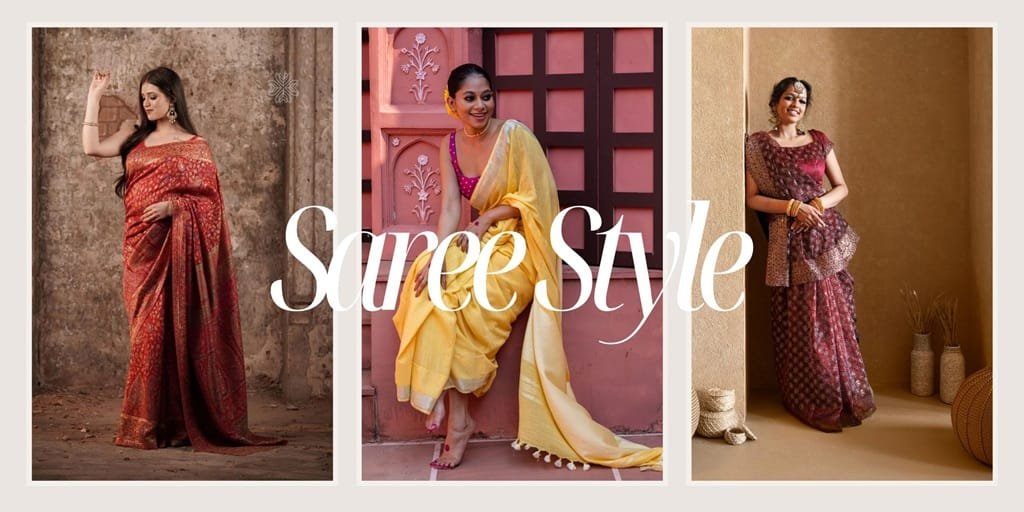
How to Style a Batik Saree
Batik already has a strong visual personality, so styling doesn’t need to be complicated.
For a colourful Batik saree, try pairing it with a solid-coloured blouse that picks up one of the secondary colours in the saree.
Oxidised silver jewellery works beautifully with earthy Batik designs, while gold-toned jewellery can complement richer Batik silk sarees.
For a contemporary look, experiment with:
- Sleeveless blouses
- High-neck blouses
- Contrast blouses
- Handloom jackets
- Statement earrings
- Minimal necklaces
- Handmade jewellery
- Terracotta accessories
The key is balance.
If your Batik saree already has an elaborate all-over pattern, let the saree remain the focal point.
How to Care for a Batik Saree
Care requirements depend on both the fabric and dyes, so always follow the instructions provided with your saree.
As a general rule:
- Avoid harsh detergents.
- Don’t soak the saree unnecessarily.
- Protect it from prolonged direct sunlight.
- Store it in a clean and dry place.
- Avoid spraying perfume directly onto the fabric.
- For valuable silk Batik sarees, professional cleaning may be preferable.
- Store silk sarees carefully and refold them periodically.
Because Batik involves dyes, colour-care instructions are particularly important.
Batik Sarees in Indian Fashion
Batik has survived changes in fashion because it can feel both traditional and contemporary.
A traditional Batik saree may have earthy colours and nature-inspired motifs, while a modern designer can use the same fundamental technique to create bold geometric or abstract patterns.
This versatility allows Batik to work across generations.
A young woman might pair a Batik saree with a sleeveless blouse and contemporary jewellery, while another wearer may style the same craft with a traditional blouse and classic accessories.
The craft remains the same.
The styling evolves.
Frequently Asked Questions About Batik Sarees
What is the meaning of Batik saree?
A Batik saree is a saree decorated using a wax-resist dyeing technique. Selected portions of the fabric are covered with wax so they resist dye, creating patterns when the cloth is coloured and the wax is removed.
What is the Batik saree making process?
The basic Batik process involves preparing the fabric, designing the pattern, applying wax, dyeing the cloth, repeating waxing and dyeing when multiple colours are required, removing the wax, washing and finishing the saree.
Is Batik a type of silk?
No. Batik is a dyeing and surface-design technique, not a type of silk. Batik can be created on silk, cotton and other suitable fabrics.
What is a Batik silk saree?
A Batik silk saree is a silk saree whose design has been created using Batik techniques. It combines the appearance and drape of silk with wax-resist patterns.
Why does Batik have cracked lines?
The characteristic crackle can occur when wax applied to the fabric develops small cracks. Dye enters some of those cracks, creating irregular fine lines that become part of the design.
Is Batik the same as block printing?
No. Traditional Batik relies on wax-resist dyeing. Blocks may sometimes be used to apply wax in certain Batik techniques, but conventional block printing generally involves transferring colour or pigment directly to the fabric.
Are all Batik sarees handmade?
No. The market also contains Batik-inspired printed sarees and machine-produced designs. If handmade Batik is important to you, ask the seller specifically about the production technique.
Which is better: Batik silk or Batik cotton?
Neither is inherently better. Choose Batik silk when you want a richer drape and more festive appearance. Choose cotton when you prefer an earthy, relaxed and potentially more everyday-friendly saree.
Final Thoughts
A Batik saree is much more than a colourful printed saree.
Behind traditional Batik lies an intriguing sequence of designing, waxing, dyeing, protecting colours, creating textures and finally removing the wax to reveal the finished artwork.
Its famous crackled lines are part of what makes Batik so visually distinctive. Instead of striving for the mechanical perfection of a digital print, handcrafted Batik celebrates variation.
And perhaps that is the real beauty of Batik.
In an age where thousands of identical designs can be reproduced with a click, a handcrafted textile reminds us that a little irregularity can make something more—not less—beautiful.
So the next time you see a Batik saree, don’t just look at its colours.
Look at the lines, the layers and the subtle variations.
Behind them lies a centuries-old idea that remains wonderfully simple:
Use wax to stop the colour, and let craftsmanship create the design.